
ComparisonAugust 21, 2026
What Is a Composite Villa Door? Why Is It the Top Choice Outdoors?
A composite door isn't a single material — it's a layered construction. What does each layer do, and why does it outperform solid wood outdoors?
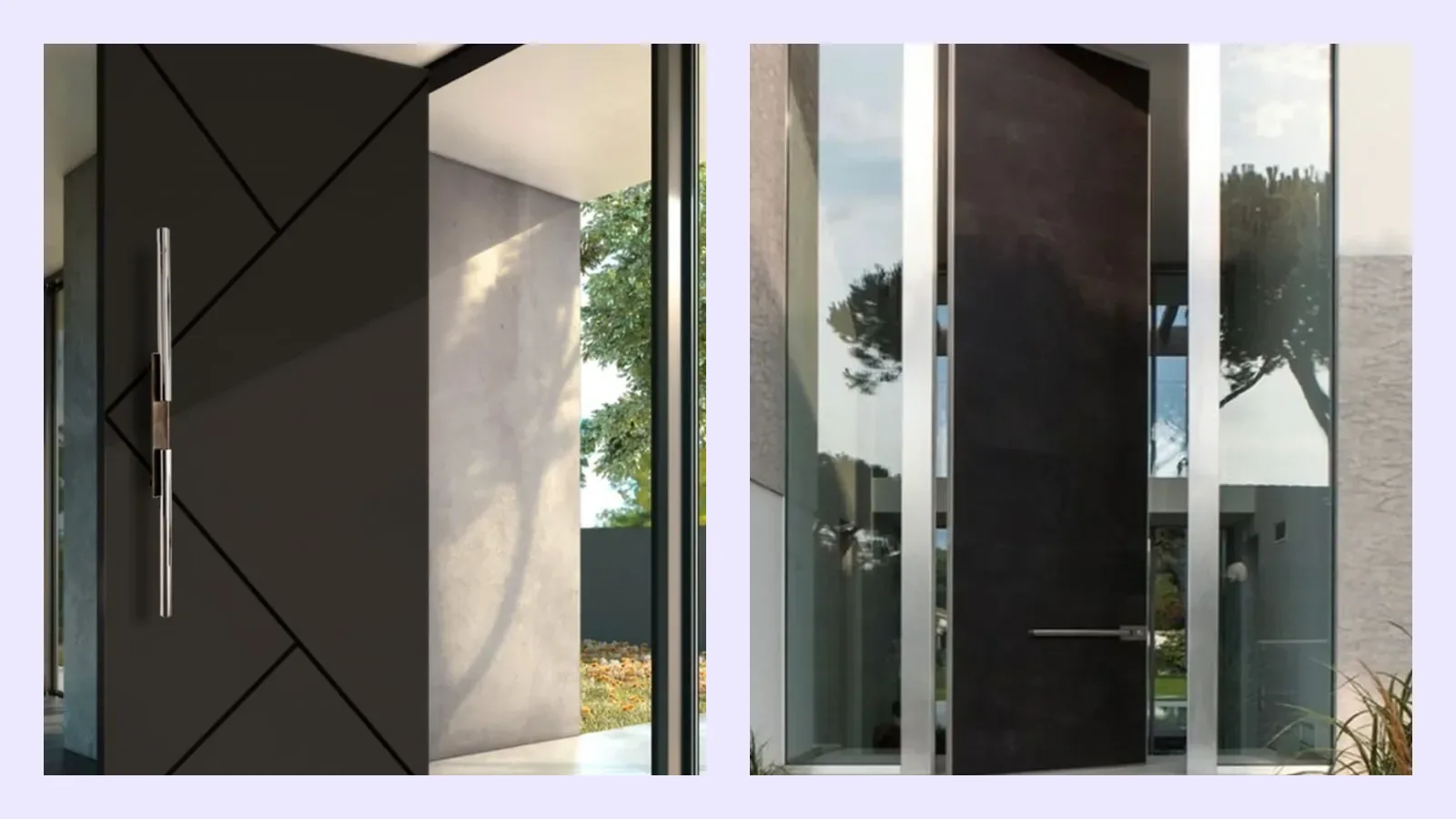
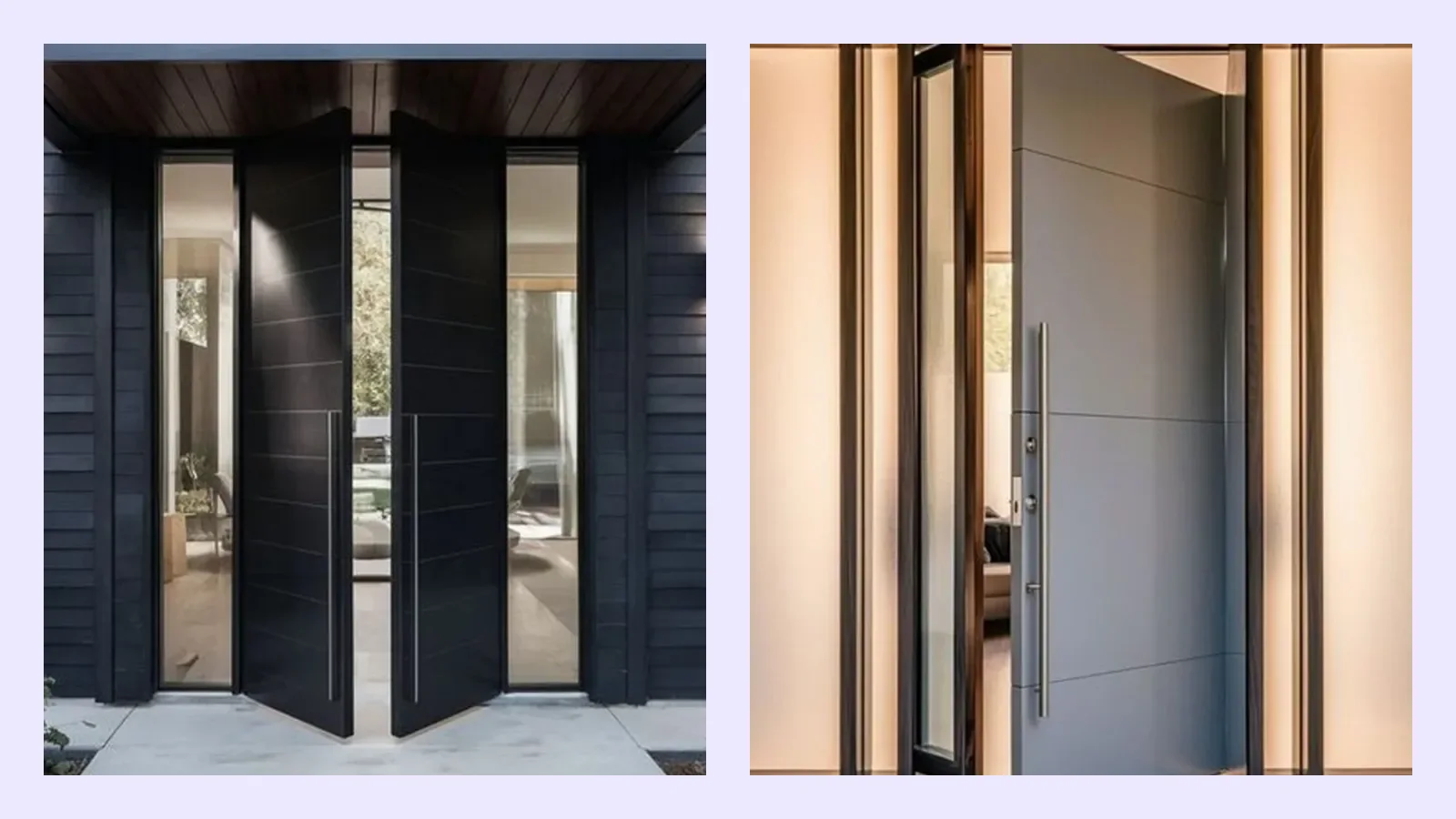
Pivot doors have rapidly become popular for villa and residence entrances in recent years. Most marketing emphasizes "modern looks," but the real difference isn't aesthetic — it's engineering. In this article we put the two systems side by side: where each makes sense, and where each causes problems.
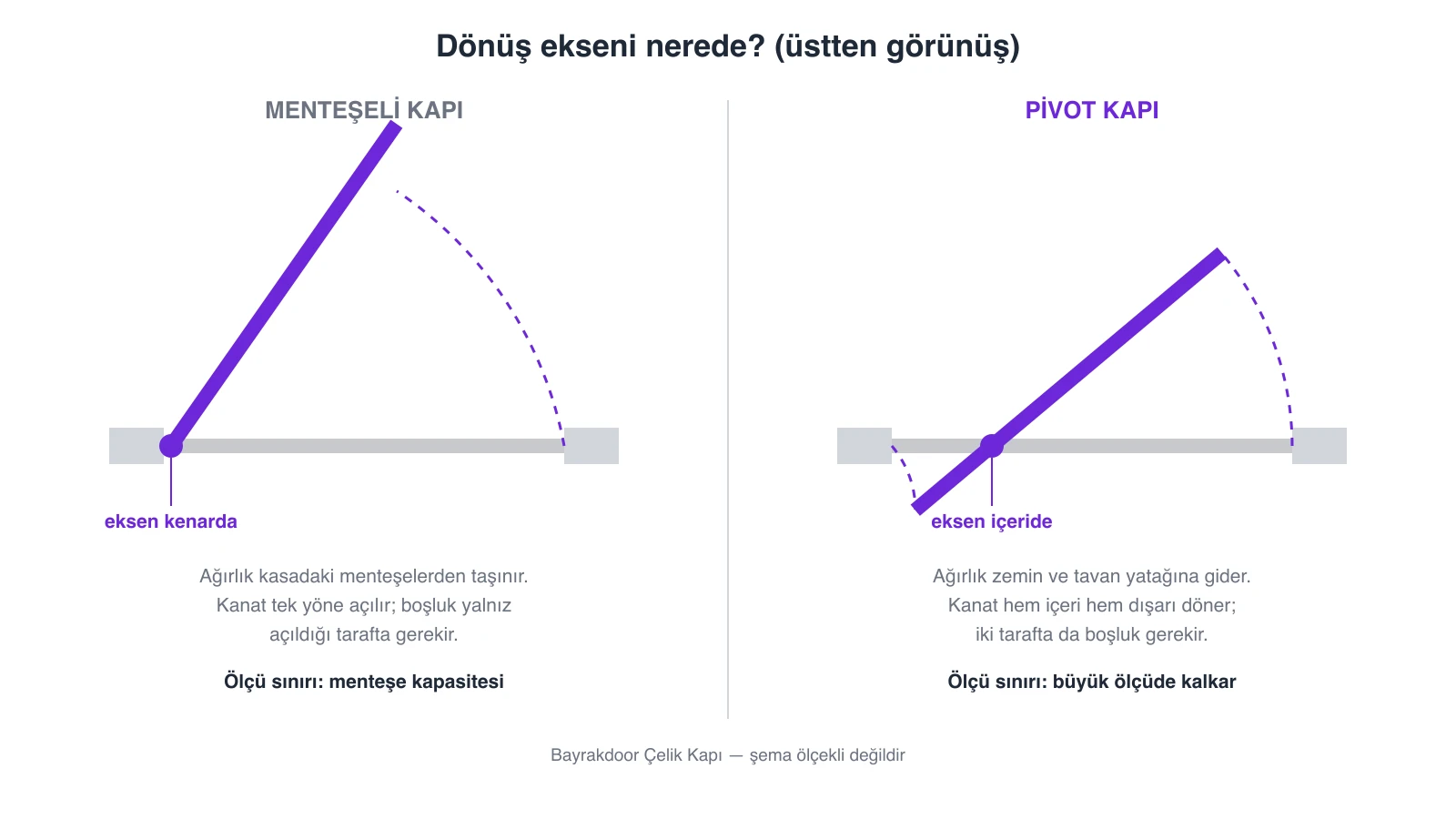
On a hinged door, the entire weight of the leaf is carried by hinges bolted to the frame. A hinge is a lever point; as the leaf gets heavier, the torque on the hinge increases. That's why hinged systems have a practical limit on leaf size — go beyond it, and the door eventually sags and starts to rub.
On a pivot door, the leaf rotates on two bearings, one at the floor and one at the top frame. The weight is transferred directly to the floor, not the frame. Since the floor can carry essentially unlimited load, the leaf-size limit is largely removed.
The takeaway: pivot isn't "a more modern hinge" — it's a fundamentally different load-bearing principle. That's why a pivot door has neither a classic hinge nor the fixed pin found on the hinge side of a conventional door — security instead comes from the locking system and the body structure.
| Hinged steel door | Pivot steel door | |
|---|---|---|
| Load transfer | Hinges bolted to the frame | Floor and ceiling bearing |
| Size limit | Limited by hinge capacity | Noticeably wider and taller leaf possible |
| Direction of swing | Opens one way | Swings both inward and outward |
| Clearance needed | Only on the side it opens toward | Clearance needed both in front and behind |
| Floor preparation | Not required | Required for the bottom bearing |
| Fixed pin | Present on the hinge side | Not present — security comes from the lock and body |
| Suitable for narrow entrances | Suitable | Not suitable |
| Cost | Lower | Higher, due to the bearing system and extra reinforcement |
Pivot makes sense when one or more of these conditions apply:
In these situations, staying with a hinged system is the better call:
"Pivot doors are less secure." This idea comes from the absence of hinges, but the opposite case can also be argued: on a hinged door, the hinge side is itself a separate vulnerability that needs to be covered with a fixed pin. On a pivot door, that side simply doesn't exist. Security in both systems is determined by lock class and body reinforcement.
"Pivot doors don't insulate well." The seal detail is indeed more critical because of the rotation axis. But when the frame is sealed on 3 sides, the leaf on 4 sides, and a drop seal is used at the bottom, insulation is no worse than a hinged door.
If the pivot decision is made during the construction stage, installation becomes noticeably easier, because the position of the bottom bearing can be planned together with the floor. It can also be applied to existing entrances; floor suitability is assessed during the site survey.
You can browse our pivot steel door models, or read our pivot door guide, where we cover the topic in more depth.
A pivot door costs more than a hinged door of the same size, and there are concrete reasons for that. First, the bearing system: the floor and ceiling bearings are noticeably more expensive components than a standard hinge, and they're selected based on the leaf's weight. Second, extra reinforcement: the area around the pivot shaft is further strengthened. Third, floor preparation, and fourth, installation time — alignment is a more delicate job than with a hinged door.
In return, what pivot delivers is a size that simply can't be produced with a hinged system. So the comparison shouldn't be framed as "the expensive version of the same door" but as "a door that can't be built any other way." Choosing pivot for a standard-sized entrance may mean paying a premium without getting anything for it.
Both are determined by lock class and body reinforcement; the system itself doesn't create a security difference on its own. On a hinged door, the hinge side is an additional vulnerability that needs a fixed pin; on a pivot door, that side doesn't exist in the first place.
Not if the leaf weight and bearing selection are correct. For wind-exposed entrances we recommend adding a closer/damper — an uncontrolled heavy leaf slamming shut can damage both the door and the user.
Not by swapping the leaf — the frame, floor bearing and top bearing are installed together. So pivot can be applied to an existing entrance, but that means a full door replacement, not a conversion. Floor suitability is assessed during the site survey.
Not when properly installed. The seal detail is more critical because of the rotation axis; the frame is sealed on 3 sides, the leaf on 4, and a drop seal is used at the bottom when the door closes.
Erdi Yavuz — Founder of Bayrakdoor Steel Doors. Over 20 years of experience in steel door manufacturing. Production takes place at our own factory in Gaziosmanpaşa, Istanbul; measuring, production and installation are handled by the same team.
You can ask about your own door, your measurements or your specific area. Our production team reads these and answers here. If you'd like a faster reply, you can message us on WhatsApp.
A composite door isn't a single material — it's a layered construction. What does each layer do, and why does it outperform solid wood outdoors?
Ask a language model this question and you'll get the same answer every time. But how long does each cladding actually last in the field? A comparison of compact laminate, composite, wood, and aluminum.
Aluminum framing is everywhere at apartment entrances. It is light and rust-free — but under forcing and heavy daily use, it simply doesn't deliver what steel does. We put the two side by side.