
When Should You Choose a Pivot Door?
The short answer: a pivot door makes sense when your door opening is too wide for a standard leaf, or when the ceiling height calls for a very tall one. For an entrance of standard dimensions, a pivot door offers no real advantage beyond the extra cost.
How does a pivot door work?
A conventional door carries its weight through hinges attached to the frame. In a pivot door, the leaf rotates on two bearings set into the floor and the top of the frame. Because the load is transferred to the floor rather than the hinges, far heavier and larger leaves can be supported.
When is a pivot door the right choice?
- When the door opening exceeds standard leaf width
- When ceiling height calls for a full-height leaf
- When the leaf carries thick cladding and is heavy
- When the architecture calls for an uninterrupted, hinge-free surface
What are the limits of a pivot door?
As the pivot leaf rotates, it sweeps both inward and outward, so clearance is needed in front of and behind the door. It is not suitable for narrow passages or entrances that open directly onto a staircase. The floor also needs to be prepared for the lower bearing, which makes installation a more planned affair than with a conventional door.
Is there a difference in insulation?
The gasket arrangement of a pivot leaf differs from that of a conventional door. Properly manufactured, it presents no insulation problem; but because of the rotation axis, getting the gasket detail right is critical. This is a point that demands experienced manufacturing.
Comparison
| Conventional hinged | Pivot | |
|---|---|---|
| Load transfer | Hinge → frame | Floor and ceiling bearings |
| Maximum leaf size | Limited | Far wider and taller |
| Clearance required | One direction | Both directions |
| Floor preparation | Not required | Required |
| Best suited to | Standard openings | Wide, tall entrances |
Whether your entrance is suitable for a pivot door cannot be judged without taking measurements. The site survey is free of charge; call 0532 689 21 46 to book an appointment.
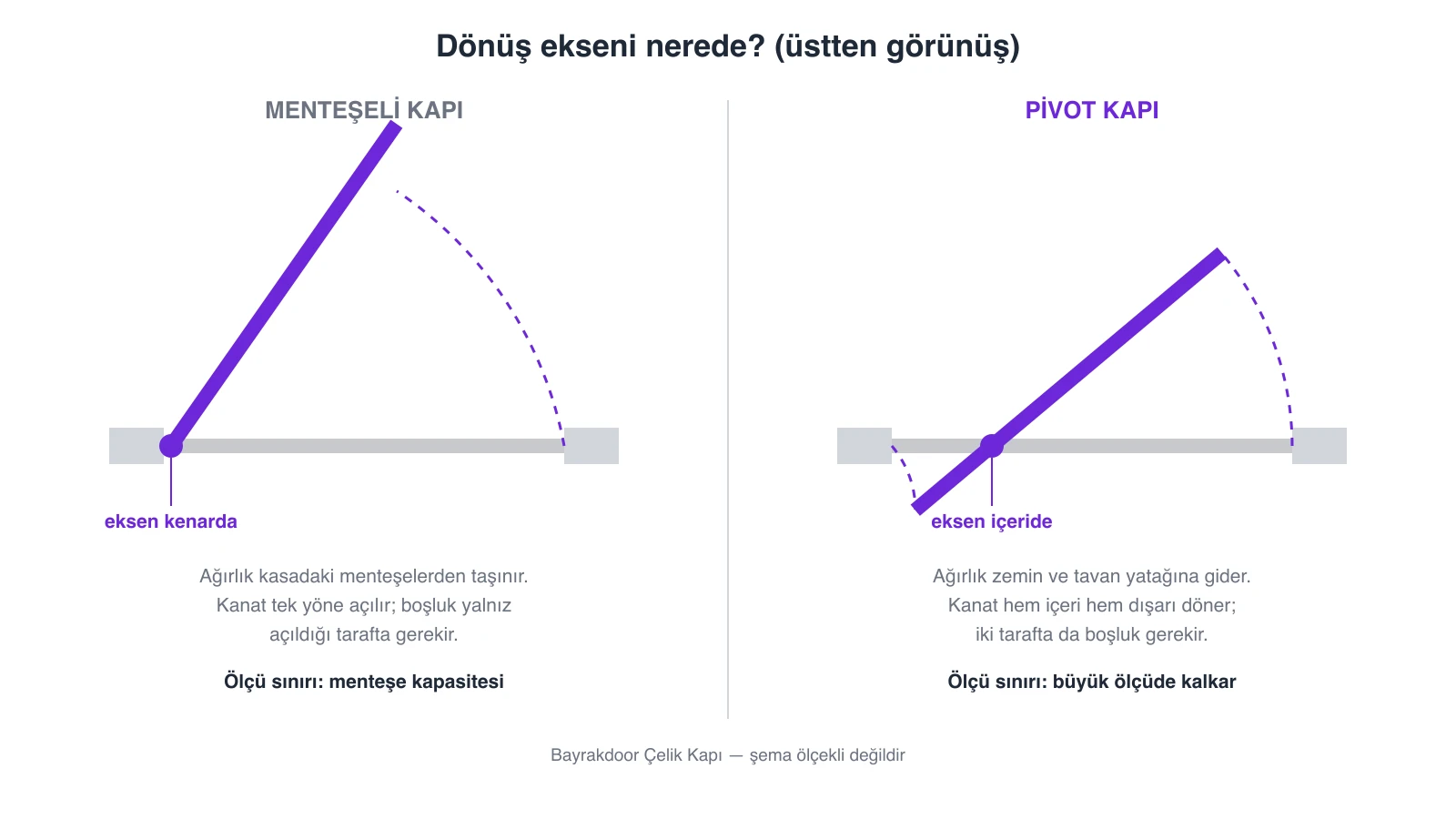
What happens in a hinged system?
In a conventional door, the entire weight of the leaf is carried by hinges screwed to the frame. A hinge is a lever point: as the leaf gets heavier, the torque on the hinge increases. Past a certain point the leaf sags, starts rubbing against the frame, and the closing line goes out of true. That is the practical size limit of a hinged system.
What changes with a pivot?
The load is transferred directly to the floor rather than to the hinges. Since the floor can carry practically unlimited weight, the limit on leaf size largely disappears. The second difference is the position of the rotation axis: on a hinged door the axis is at the edge of the leaf, on a pivot door it is inside it. This is why a pivot leaf sweeps both inward and outward as it opens.
Why are there no hinges or fixed security pins?
Since a pivot door has no conventional hinges, it also has no hinge-side security pins. Security comes from the locking system and the structural body of the leaf. This is not a shortcoming but a different design: on a hinged door, the hinge side is a vulnerability that needs separate protection, whereas on a pivot door that side simply does not exist.
What does floor preparation involve?
The floor needs to be prepared at the point where the lower bearing sits. If the decision is made during construction, this preparation is planned along with the flooring and installation becomes straightforward. It can also be applied to existing entrances; the suitability of the floor is assessed during the survey.
Where should it not be used?
- Entrances opening directly onto a staircase. Because the leaf also swings outward, it would intrude into the stairwell.
- Narrow landings. If there is no swing clearance in front of and behind the door, a pivot will not work.
- Apartment flat entrance doors. Corridors are narrow, and it is not suited to shared-space use.
How we build pivot doors
In our pivot models, the frame is 2 mm Ereğli A1-grade DKP sheet steel and the leaf is a 1.5 + 1.5 mm monoblock pressed-panel system; the lock zone and the area around the pivot shaft are reinforced with 3 mm steel. Locks are Italian Mottura or Mul-T-Lock, with card, keypad, or fingerprint entry added on request.
We cover where the size limit begins in our article on oversized entrance doors, and compare the two systems in pivot vs. hinged doors.
Where does the cost difference come from?
A pivot door costs more than a hinged door of the same size, and for concrete reasons: the floor and ceiling bearings are significantly more expensive components than standard hinges and are selected according to the weight of the leaf; the area around the pivot shaft is additionally reinforced; floor preparation is required; and installation alignment is more precise.
The comparison should not be framed as "a more expensive version of the same door" but as "a door that cannot be built any other way." Choosing a pivot for a standard-sized entrance may mean paying a premium you never see the benefit of.
Transport and installation logistics
With oversized leaves, the question most often overlooked is whether the leaf can actually be carried to the entrance. A leaf 140 cm wide and 260 cm tall will not fit through a narrow stairwell or a standard lift. At villa entrances this is rarely a problem; on upper floors and in narrow streets it needs to be planned in advance.
During the survey we assess the access route, turning angles, and whether a crane will be needed.
Related models
You can browse all models in our product catalog and read about our manufacturing process on the About Us page.
Frequently Asked Questions
Is a pivot door more secure than a conventional door?
Security comes from the leaf material and the lock system, not from the way the door turns. With the same sheet steel thickness and the same lock, there is no difference in security between a pivot door and a hinged one.
What floor preparation does a pivot door need?
The floor has to be prepared at the point where the bottom bearing sits. That is why it is easier to decide on a pivot door during construction than afterwards. It can still be fitted to an existing entrance; we assess the condition of the floor during the site survey.
How large can a pivot door be made?
Because the load is carried by the floor, pivot leaves can be made noticeably wider and taller than hinged ones. The exact limit depends on the weight of the leaf and the bearing chosen, and is set project by project.
Does a pivot door swing out of control in the wind?
Not when the leaf weight and the bearing are matched correctly. For exposed entrances we recommend adding a damper; a heavy leaf closing uncontrolled damages both the door and whoever is using it.
Can my existing door be converted to a pivot door?
Not by swapping the leaf alone; the frame, the floor bearing and the top bearing are installed together. A pivot door can certainly go into an existing entrance, but that means replacing the door. Whether the floor is suitable is assessed during the site survey.
Is a pivot door hard to open because of its weight?
A correctly installed pivot door opens with one hand despite its weight, because the load goes into the floor and there is very little friction in the bearing. If it is hard to open, the bearing adjustment or the alignment is at fault.